edge-based AI
What is Edge AI?
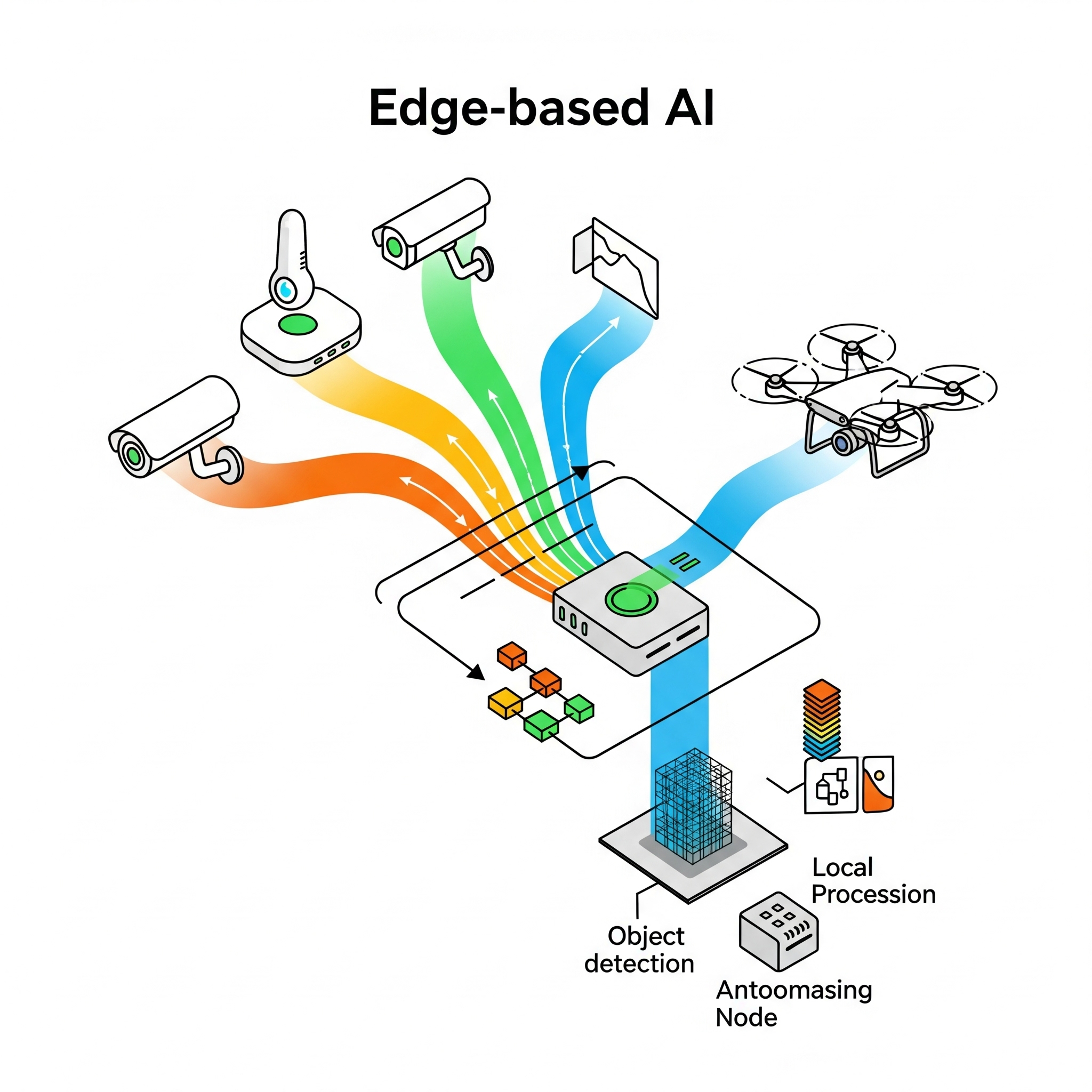
Edge AI is the convergence of edge computing and artificial intelligence, enabling data processing and decision-making directly on local devices—closer to the source of data generation—rather than sending all data to centralized cloud servers. This architecture reduces latency, boosts speed, and enhances data privacy. Instead of depending on a remote data center, Edge AI makes use of local hardware such as smartphones, embedded systems, smart sensors, and IoT devices to perform real-time inference with minimal delay.
What is the Edge in AI?
The “edge” refers to the periphery of the network, where data is originally created. Edge in AI implies deploying machine learning models on devices or gateways that are located at or near this data source. By bringing AI capabilities like computer vision, natural language processing, and predictive analytics to edge devices, companies are redefining the structure of smart, scalable solutions that respond instantly and securely without relying on the cloud.
What AI Does Edge Use?
Edge AI leverages a range of artificial intelligence technologies:
-
Convolutional Neural Networks (CNNs) for real-time image classification and object detection.
-
Recurrent Neural Networks (RNNs) and Transformers for natural language and time-series data processing.
-
Reinforcement Learning for autonomous navigation and robotics.
-
Lightweight ML frameworks such as TensorFlow Lite, ONNX Runtime, and PyTorch Mobile, specially optimized for running on constrained devices.
These models are trained centrally and then compressed, quantized, or pruned for efficient execution on resource-limited edge devices.
Edge AI Examples
Here are some cutting-edge applications of Edge AI:
-
Smart cameras using AI for real-time facial recognition and surveillance.
-
Autonomous drones that navigate and make decisions locally using embedded AI processors.
-
Wearable health devices like smartwatches analyzing ECG or heart rate variability without uploading sensitive data.
-
Industrial IoT sensors monitoring equipment health and predicting failures using AI on the edge.
-
Smart retail shelves detecting stock levels and customer interaction in real-time.
Edge-Based AI Applications
The real power of Edge AI lies in its versatility. Industries across the board are integrating Edge AI into their infrastructure:
-
Healthcare: AI-powered diagnostic tools on handheld devices for rural and underserved regions.
-
Manufacturing: Smart robots and real-time quality control on the production line.
-
Retail: Edge AI for foot traffic analytics, queue management, and personalized marketing.
-
Transportation: Self-driving vehicles and smart traffic systems.
-
Agriculture: Crop monitoring drones using Edge AI to optimize yield prediction and pest control.
What is an Example of an Edge AI Application?
A notable example is Tesla’s Full Self-Driving (FSD) system, where vehicles use embedded AI chips to process data from multiple cameras and sensors for autonomous navigation. These operations are executed in real-time directly on the car’s edge hardware, minimizing latency and ensuring split-second decision-making—an essential aspect for safety-critical applications.
What are the Disadvantages of Edge AI?
Despite its transformative potential, Edge AI is not without limitations:
-
Limited computing resources: Edge devices have constrained power and memory, making deployment of large models challenging.
-
Hardware dependency: Not all devices are equipped for AI inference at the edge, requiring hardware upgrades.
-
Complex updates: Deploying and managing software updates across thousands of distributed devices is complex.
-
Security risks: While data is localized, compromised edge devices can become security vulnerabilities.
-
Model accuracy trade-offs: Compressing models to fit on edge hardware can reduce inference accuracy.
Which Edge AI Platform is Best?
Several platforms stand out in the Edge AI ecosystem:
-
NVIDIA Jetson: Offers powerful GPU-accelerated computing for edge inference and robotics.
-
Google Coral: Lightweight, cost-effective solutions for TensorFlow Lite models with Edge TPU accelerators.
-
Intel OpenVINO: Enables high-performance inference across Intel CPUs, VPUs, and FPGAs.
-
AWS IoT Greengrass: Extends AWS cloud capabilities to edge devices for managing ML inference.
-
Microsoft Azure Percept: Integrates Azure cloud AI with edge devices for computer vision and audio processing.
Each platform has its strengths depending on use case, scalability needs, and integration ecosystem.
How to Learn Edge AI?
To get started with Edge AI, follow this roadmap:
-
Learn the fundamentals of machine learning and deep learning (TensorFlow, PyTorch).
-
Study edge computing architecture and IoT systems.
-
Experiment with development boards like Raspberry Pi, NVIDIA Jetson Nano, or Arduino.
-
Use lightweight ML frameworks such as TensorFlow Lite, ONNX, and PyTorch Mobile.
-
Participate in open-source projects and contribute to Edge AI libraries.
-
Take specialized online courses such as:
-
“Edge AI and Computer Vision” on Coursera
-
“AI at the Edge” by Nvidia Deep Learning Institute
-
“IoT and Edge AI for Beginners” on edX
-
Edge-Based AI Tutorial
Here’s a brief example tutorial outline for running an Edge AI application:
Objective: Deploy a real-time object detection model on a Raspberry Pi with a camera.
Steps:
-
Install Raspberry Pi OS and setup Python environment.
-
Download TensorFlow Lite model (e.g., MobileNet SSD).
-
Connect a camera module and install OpenCV.
-
Use Python to load the TFLite model and begin video capture.
-
Apply model inference on each frame and draw bounding boxes.
This hands-on project introduces the essentials of processing video streams locally using optimized deep learning models.
Edge AI Projects
Here are project ideas to sharpen your skills in Edge AI:
-
Smart traffic light controller with image recognition.
-
Wearable posture correction system using accelerometer data.
-
Edge AI-powered greenhouse monitoring system.
-
Voice-controlled home automation system on a microcontroller.
-
Industrial anomaly detection sensor with Edge TPU.
These real-world use cases strengthen understanding of deployment, model optimization, and system integration.
Edge AI Companies
Some of the top players leading innovation in Edge AI include:
-
NVIDIA: With Jetson modules and CUDA-accelerated deep learning.
-
Qualcomm: Pioneering low-power AI chips for mobile and embedded use.
-
Google: Offering Coral Edge TPU and AI tools for fast inferencing.
-
Intel: Powering edge AI with OpenVINO and neural compute sticks.
-
Siemens: Integrating edge AI in industrial automation and smart manufacturing.
-
Hailo: Specializes in edge AI processors designed for high efficiency and performance.
Conclusion
Edge AI is not just a passing trend—it’s the next frontier in artificial intelligence and distributed computing. As industries demand faster, more efficient, and more secure AI systems, edge-based intelligence will play a crucial role in redefining digital infrastructure. From autonomous vehicles to smart health monitors, Edge AI is shaping the future in real-time—right where data happens.
About the Author